
Everything is a Relationship
and all Relationships are an Obligation

What gets left behind when we extract? Commitment. Obligation. Community that makes demands on you. The sense that your practice is bound up with other people’s lives and not just your own nervous system. - Liz Bucar , Religion Is Back. The SBNR Helped.
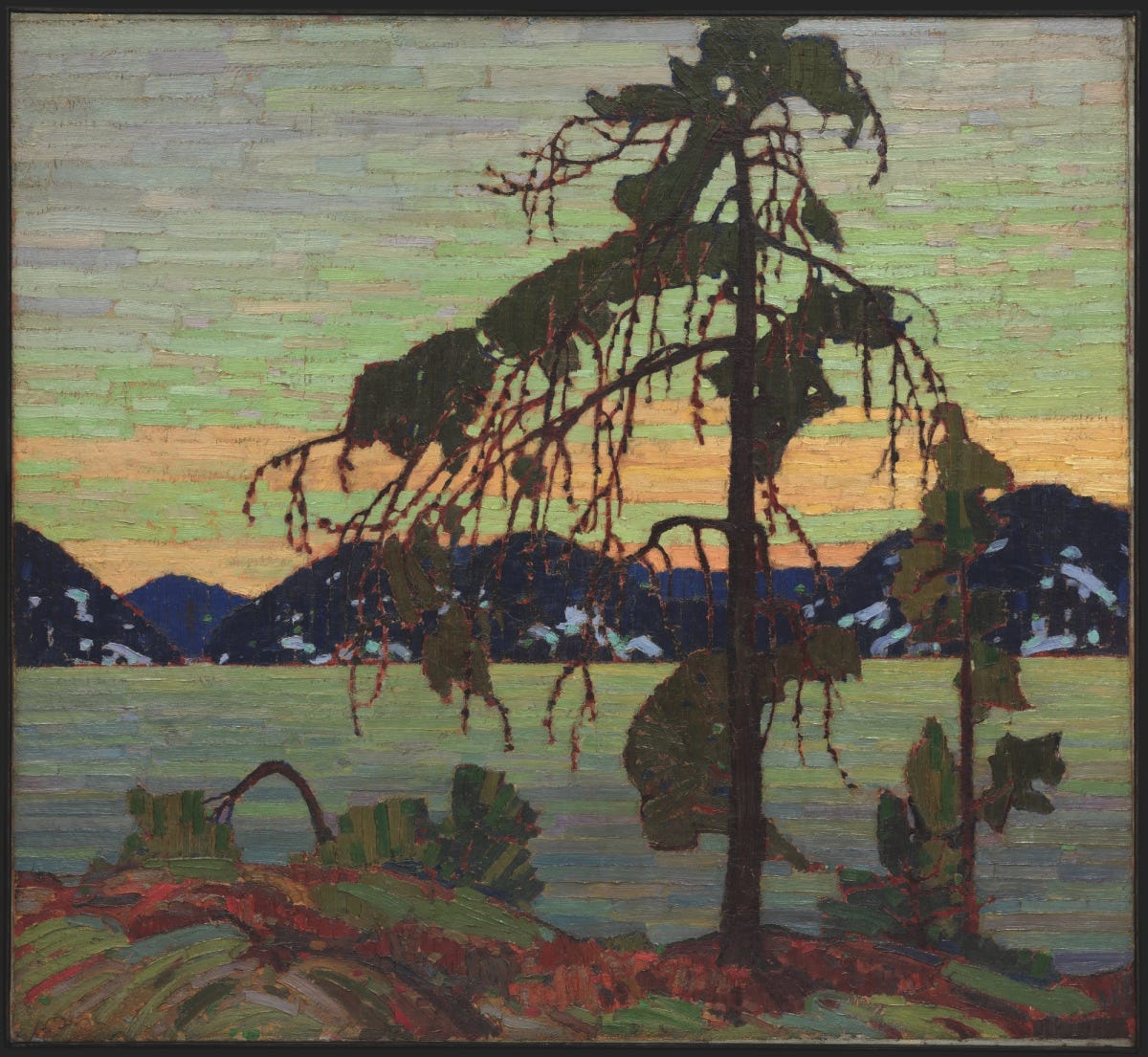
Outside my apartment is a tree, a poplar if my mind and eyes don’t deceive me. It’s rooted at the corner of the house, right at the top of the stairs up and out of the basement. When I moved in it was a small runt of a thing that I suspected would die. Somehow a seed managed to find soil in a crack in the uneven asphalt that covers my backyard. It is nestled tight between my neighbour’s fence and the house itself. Nearly nine years later that runt of a tree had pushed away the asphalt and extended its branches tall and wide.
The canopy now covers almost the entire patch of concrete that is the backyard of the house. It provides needed shade and passive cooling for myself and the other residents who live in this shared house. Birds and squirrels congregate in it. More than a few nights I’ve startled some raccoons that have fled up its trunk and along its branches to escape me. That tree also tried to give me another, this one somehow rooting in the crevice of a stair down into my home. That little poplar couldn’t remain where it was so I uprooted it and threw it into the small patch of garden that I have re-wild. That sapling is now a storey taller than the garage, its arms reaching out, entwining with the elder poplar. The youngling is now also a refuge for the birds and squirrels of my neighbourhood, though I am not sure a chunky raccoon could escape up it yet.
At first blush it may seem a bit odd to begin our time together talking about trees but I assure you there is a reason. You see, relationships are more than connections to other people. They are that, to be sure, but they are also about how we relate to the more-than-human as well. I have a relationship with that tree. It is part of my community as surely as my neighbours who share this converted house are.
Having a tall, full tree rooted maybe a metre from your top step is an exercise in compromise. It leans out over the entire yard, and its limbs stretch every which-way seeking sun and moisture. Trees care little for human settlements meaning that if I wished to keep my tree I had to learn to work with it, to negotiate and to terms with a mouthless interlocutor. So when branches sprawled out, blocking the entrance to my home I had to make a choice. The easy choice was to remove the offending limbs, amputating them from the trunk and hoping that severing them did not invite disease or stress that would kill the poplar. Felling the tree was also an option. The roots threaten the foundation of the house and the highest branches are now entwined with the wires that route power, cable, and internet to the house on the other side of the fence, after all.
While practical, these solutions didn’t sit well with me. Cleaving off pieces would rob me of shade, the squirrels their playground, and the juncos, sparrows and finches of shelter. Cutting the poplar down would even be more drastic, leaving all of us with nothing but a scar of a stump in place of the beautiful poplar. So instead taking a ripping, tearing blade to the the tree I spent an hour or so a couple of springs ago tying smaller, lower branches to thicker branches much higher up with sisal rope, bending the thin, pliable shoots up out of my way. This pulled the foliage out of eye level, and out of the way of my abode, ensuring my safety while maintaining the integrity of the tree and the web of life that it supported. Relationship maintained. Obligations fulfilled. And today, those branches and leaves that were a bit dangerous two springs have grown up, away, and over my head and are no longer a hazard at all.
This little story, of me and a tree, makes me think of Nectaire and his garden. A place with creatures both meek and powerful could gather to hear the satyr play his flute while seeking refuge and respite from the harshness of life. It also makes me think of Mark Cladis and his thoughts on the Wordsworths, Thoreau, and DuBois in Radical Romanticism: Democracy, Religion, and the Environmental Imagination. In his book, Cladis reminds us that the line between civilization and nature is artificial and permeable. Mankind is never far from the wild, nor is the wild ever far from us. One might even say that there is no line between the two. We are reliant on nature, after all. The opposite is less true.
This reciprocal relationship is something alien to many other forms of Satanism. Historically, Satanism has been focused on a selfish deification, both as a spiritual practice and as a literary trope. This is most clearly expressed in Anton Lavey’s writings, which are a mix of Ayn Randian objectivism, cynical and lazy ‘might is right’ social Darwinism, all tied together with ritualized pomp, circumstance, and more than a little bit of nudity. In literature, the most famous Satan, Milton’s, sexy, suave, and sophisticated in the beginning but by the end of the epic is nothing more than a defeated, self-deluded figure to be, at best, pitied. Often pre-Temple Satanism was nothing but small, petty bravado; a simulacra of strength and nobility, a Potemkin village of a mind-palace that asks practitioners, or readers, to selectively ignore certain passages to wash the ignobility of the words clearly written on the page.
Temple Satanism offers a quite different understanding of Satan and Satanism. Our Satan is the Satan of Anatole France, the great archangel of The Revolt of the Angels. Our Satan is not contemptuous, is uninterested in meaningless conflict with Ialdabaoth, nor is he in tempting mankind. He has abandoned spite for the finer things in life; learning, teaching, and companionship. Rebellion has been replaced with Revolt. Nurture has superseded violence. (Check out Revolt of the Angels, or the Eternal Rebel by Koroc Teufelszunge for more.)
Our Satan is more Promethean, more Epicurean than most others. The great archangel and his followers are “the friendly demons who teach all truths” to humankind. To the angels in revolt we were not things to be toyed with or corrupted, but to be embraced as kin. As Nectaire said of us “though lowly folk, they were our brothers, and we were never loath to come to their aid.” The friendly demons, though fearsome, are not to be feared but respected. They are helpers, not corruptors. Like an older, wiser sibling or cousin who took it upon themselves to shepherd us from ignorance towards enlightenment as they saw themselves reflect in us. In return we humans left offerings of thanks and praise. Through simple reciprocity the humans and angels of The Revolt of the Angels found themselves freer, greater, and more cultured by choosing collaboration over selfishness, thanks over greed. This is not unlike how in the real world we offer honorifics to teachers today, or pay for a pint and meal when we ask our friends to lend their expertise to a problem we are struggling with.
The impetus towards relationships and obligations to others doesn’t end in The Revolt of the Angels in Temple Satanism. The Better Angels of Our Nature is also a study of how humans can come together to be more than we ever could as solitary creatures. While all of Pinker’s civilizing forces are rooted in human cooperation, the most important may be his defence and appeal to Thomas Hobbes’s Leviathan. The core argument of Hobbes is that humans, through enlightened self-interest, can choose to come together, moving from me to we, to multiply the bounty we can all share in. Sure, in a state of war against all, we are completely liberated - able to do whatever we want, to whomever we want, whenever we want so long as we are willing to suffer the consequences - but that as rational, thinking beings we know a better option is possible. By giving up small liberties - like being able to murder, rape, and plunder - we are more free than if we retained those liberties. Putting away tools of unlimited violence created opportunities for meaningful collaboration. Survival no longer being a zero-sum game unleashed the human spirit, allowing us to create art, philosophy, science, and culture. Life no longer being solely about base needs allowed for human flourishing. In other words, freedom can only grow when we embrace relationship and obligation.
Temple Satanism has taken the lessons of The Revolt of the Angels and The Better Angels of Our Nature and codifies them into The Seven Fundamental Tenets.
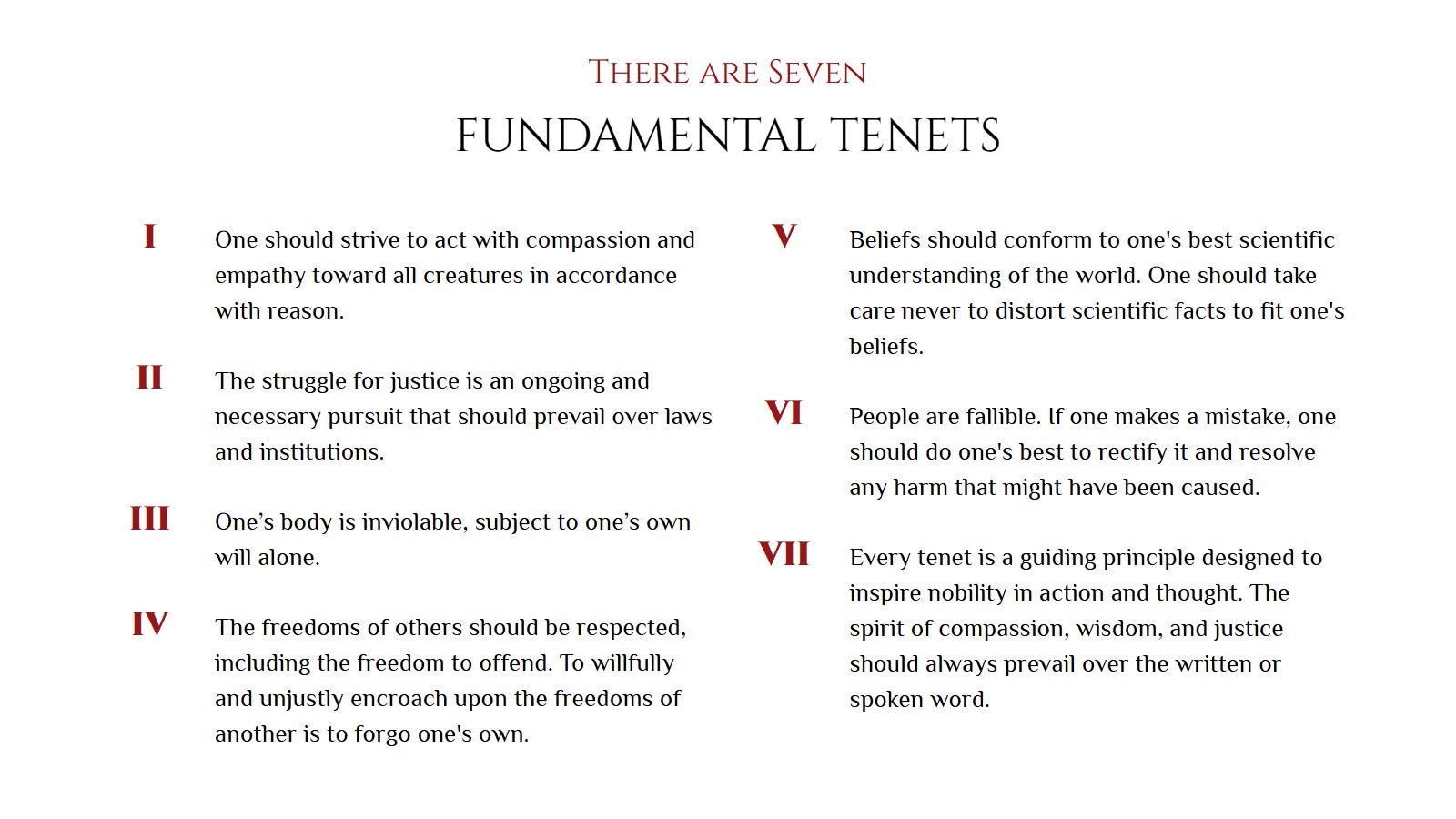
One of the things that has always struck me about the Seven Fundamental Tenets is that only one of them, Tenet III, is focused upon the self. The rest are about how Temple Satanists should move through the world. They are about how to be relationships fellow Satanists, the rest of humankind, and with the more-than-human world. It’s a moral framework that centres one’s self within your own life, but does not centre one’s self in all of life. The Seven Fundamental Tenets asks Temple Satanists to think about our obligations to our neighbours, to strangers in far away places, to animals, to the plants, to air and soil. What is owed and what is due become moral and ethical imperatives, not mere transactions on a ledger in Temple Satanism.
For me, this relationship extends past not only humans and nature but the items that adorn my house. My cellphone, the keyboard I type this on, the books I read, and even the various tchotchkes and mementos that adorn my house are all things I view as being in relationship with. Items need to be cleaned and maintained, after all, but beyond that every piece of plastic or paper has been extracted from the Earth by labourers I have never seen. And each tree cut down, each mineral mined, and each mile driven has irrevocably changed the ecosystem that plants, animals, and we all share.
Each of us sits in the centre of a web of relationships so vast that we can not comprehend it. At best we can abstract our relationships into a simplified picture from a textbook or computer model that renders incalculable variables into a couple of charts and graphs that we can understand. This is always done in service of flatten these relationships to the point we can understand them. But in doing so we (inadvertently?) normalize what relationships we think are valuable. Markets and economics maybe the most prominent ways we normalize our relationship priorities but they are far from the only ways. Religion and nationalism, for example, also provide different answers to what types of relationships should be prioritized or not.
Thinking about the world this way has changed the way I approach everything in my life, from household chores, to personal relations, to community involvement, to political arguments, and even my theology. Each relationship we nurture creates more freedom in that direction. Each relationship we neglect binds us in chains, locking us into certain ways of being that we can never truly return to. As a passionate polemic it’s been a hard lesson to incorporate, one I fail to do well on many days, but a valuable lesson to practice even in such a limited way. Freedom is worth accepting the obligations of relationships. Besides, I know the birds, squirrels, and tree have appreciated my efforts.
Special Note: Everything is a relationship is not my concept. It is a way of viewing the world from my partner, the beautiful and wise Jen Saxena. So much of what I write comes from our conversations. I am in perpetual debt to her, as are you if you enjoy my writing, because without her nothing I share would be half as deep or interesting.
Reminds me of the fact that I often read excommunicated Satanists say "Now I don't have to answer to anyone. I can do and say whatever I want!" I think about how empty that kind of life is. Responsibility and purpose to those we trust are the very things that make life matter.
This is an exciting topic - the root of civilization was born through care for others, namely the historical discovery of a human femur which was healed - Margaret Mead made the connection between the healed bone and one of the earliest known signs of civilization. It predates when archaeologists believe Gobekli Tepe was built by nearly 18,000 years (the site is thought to have existed 20,000 years before Mesopotamia began). Human connection, compassion, and care for the environment are signs of evolution. Great read 🖤