
Our Better Angels
Why 'The Better Angels of Our Nature' Matters to Temple Satanists

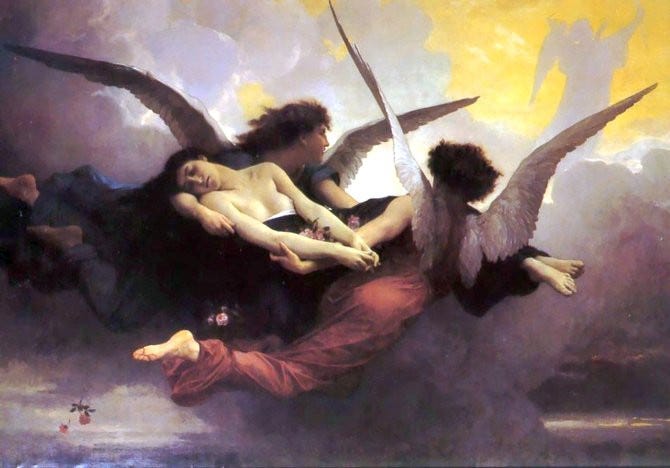
Two loves I have of comfort and despair,
Which like two spirits do suggest me still,
The better angel is a man right fair:
The worser spirit a woman coloured ill.
To win me soon to hell my female evil,
Tempteth my better angel from my side,
And would corrupt my saint to be a devil:
Wooing his purity with her foul pride.
And whether that my angel be turned fiend,
Suspect I may, yet not directly tell,
But being both from me both to each friend,
I guess one angel in another’s hell.
Yet this shall I ne’er know but live in doubt,
Till my bad angel fire my good one out.‘Sonnet 144’ by William Shakespeare
I would like to begin our reflection on Steven Pinker’s The Better Angels of Our Nature with a reading from The Revolt of the Angels, Chapter 21.
During this time of great terror when Papists and Reformers rivalled one another in violence and cruelty, amidst all these scenes of torture, the mind of man was regaining strength and courage. It dared to look up to the heavens, and there it saw, not the old Jew drunk with vengeance, but Venus Urania, tranquil and resplendent. Then a new order of things was born, then the great centuries came into being. Without publicly denying the god of their ancestors, men of intellect submitted to his mortal enemies, Science and Reason, and Abbé Gassendi relegated him gently to the far-distant abyss of first causes. The kindly demons who teach and console unhappy mortals, inspired the great minds of those days with discourses of all kinds, with comedies and tales told in the most polished fashion. Women invented conversation, the art of intimate letter-writing, and politeness. Manners took on a sweetness and a nobility unknown to preceding ages. One of the finest minds of that age of reason, the amiable Bernier, wrote one day to St. Evremond: ‘It is a great sin to deprive oneself of a pleasure.’ And this pronouncement alone should suffice to show the progress of intelligence in Europe. Not that there had not always been Epicureans but, unlike Bernier, Chapelle, and Molière, they had not the consciousness of their talent.
Quoting The Revolt of the Angels may seem like an odd choice when we are here to deliberate upon Pinker’s The Better Angels of Our Nature but I assure you there is reason, not madness, behind my decision. The passage quoted, taken from the end of The Gardner’s Story, parallels Pinker’s arguments almost perfectly. There is violence in the past. The dawning of reason freed mankind from superstition. Manners, politeness, and discourse are given credit for the civilizing of society. The Bernier that Nectaire references is Francois Bernier who, at the time, was known for his travels that brought stories of far off lands to Europe which hints at the power of commerce and cosmopolitanism to link ‘the Continent’ to the rest of the world. In fact, the only thing that Nectaire does not touch upon in this part of his story is Levianthan, the great states who imposed law and order upon man in the wild for the benefit of all. Though it should be noted that in previous parts of his story, the old satyr does wax about the glory of the Roman Empire and lament its downfall as it threw Europe into centuries of conflict dominated by vainglorious warlords.
What this shows is that Anatole France and Steven Pinker share a narrative, a whiggish belief about the nature of man moving from primitive to civilized, from ignorant to wise, from criminal to just. Not only do they share a narrative, they attribute that growth to the same mechanisms. The texts are synergistic despite the nearly 100 years between their writings. Of course, there is a major difference between the two. Anatole France was writing fiction. Steven Pinker claims to be doing social science.
When doing science one tends to stick to their field of expertise. Pinker’s fields of expertise are cognitive science and psycholinguistics. The Better Angels of Our Nature is neither of those things. What it is, is a grand narrative that tries to pull the domains of philosophy, archeology, anthropology, history, economics, criminology, political science, and more together to form a single, unified theory on the history of violence and its decline. And like all people who have attempted to pull together a grand narrative before him, Pinker made a lot of mistakes. The result is an incredibly flawed text masquerading as good science. As Temple Satanists, this is something that we need to reckon with.
One of the things that the Seven Fundamental Tenets exhorts us to do is to “take care never to distort scientific facts to fit one’s beliefs.” Given the numerous significant errors in The Better Angels of Our Nature along with various alternate, good-faith and reasonable interpretations of the data Pinker cites that he chooses to reject or ignore, it is fair to question whether or not Pinker took care to avoid distorting the facts to suit his narrative. What is less fair is to cast aspersions about Pinker’s motivations for doing so. I do not know his mind but, in general, Pinker seems to be an earnest, sincere man. As such, it is quite likely that he simply made earnest and sincere mistakes. At the very least this seems more plausible than him maliciously trying to put one over on the public. We also need to separate our feelings about Pinker and his stance on transgender folx from his book, and its inclusion as part of TST’s Primary Texts. Retroactively applying our feelings about including The Better Angels of Our Nature in TST’s primary texts back in 2014-ish based on our opinions of the writer’s actions in 2024 does not serve us. To do so would be a substitution fallacy, replacing an easy answer - “How do we feel about Steven Pinker?” - for the much harder question of “Why does this book matter to TST?” Our goal is to look at the merits of the book, not to judge the soul of the man. Satanists should leave damnation to Iadabaoth. Finally, remember that the awareness of Pinker’s mistakes were not widely known outside academia when our Primary Texts were constituted. It is arguable that they still aren’t widely known as The Better Angels of Our Nature remains a wildly popular book and Pinker a widely cited public intellectual.
Now that we have acknowledged and addressed our emotional biases towards Steven Pinker the man, and been made aware that there are significant flaws in the arguments made in his book, let’s get into the reasons why The Better Angels of Our Nature is still important to us.
1. A Satanic Counter Narrative
The Better Angels of Our Nature provides a powerful counter narrative to both Laveyanism and Western hegemonic Christianity. Pinker, like Lavey and the Christian theologians of the Catholics and Protestants, starts from the assumption that we as humans are deeply flawed but Pinker then offers a very humanist solution to that problem; we just need to think, work together and compromise. This is deeply at odds with the selfish, Ayn Randian objectivist values that Lavey shared over his lifetime while also being at odds with the Western Church who says the only way to atone for your flawed nature is to accept the burden of sin and supplication to an unseen authority.
Pinker, citing Hobbes, rejects both Lavey and the theologians to rightfully point out the great efforts we as a species have made to come together and build things bigger than ourselves. Yes, we do fail from time to time, something Pinker does acknowledge, but he wholeheartedly believes that we are not victims of providence or genetics. The Better Angels of Our Nature is his attempt to prove that we are the masters of our own fates. That we can bend the arc of history towards the good.
2. We Need Hope
Pinker sees himself as a messenger of hope, and The Better Angels of Our Nature is his manifesto. However, his hope seems to be mixed with an inevitability of progress. This is the whiggishness that I mentioned previously. Moreover, he seems to be unreasonably optimistic that the exact systems that are responsible for today’s ills can solve them. We just have to ‘Enlightenment better’ seems to be his message.
Pinker isn’t the only one who seems to fall into this trap. He’s often lumped in with the New Optimists, a group of thinkers who have tried to counter societal doomerism with stories about how much better things are now compared a decade, a century, or a millennia ago by putting their faith in human exceptionalism to get us out of the numerous crises that we find ourselves in today. Lauren Berlant might call this Cruel Optimism. I see it as a variation of the Just World Fallacy.
Despite my rejection of the hope Pinker offers, I think there is a truer hope in The Better Angels of Our Nature narrative that he chose to ignore. I call this type of hope Satanic Hope. It is a hope that rejects magical thinking and the shirking of responsibilities.It is a hope based on understanding what is possible and then doing the work to make the possible real. It is the commoners who bend the arc of history towards the good, not great men nor manifest destiny. Satanic Hope is the hope of cosmopolitanism, commerce, and Leviathan. Satanic Hope is people coming together to ensure the tides raise all boats. Pinker’s whiggishness downplays these efforts despite them being obvious to me in the stories he tells.
3. Myths Matter
We are storytellers by nature. Meaning is extracted not from thin air but from shared relationships. The Better Angels of Our Nature is and should be part of our shared narrative. It helps us articulate our beliefs and our anti-beliefs as part of a collection of unifying texts that includes The Revolt of the Angels, Speak With The Devil, and The Little Book of Satanism. Better Angels is part of our origin story that helps to explain why we are different. And while Pinker may still defend its academic rigour, that does not mean that we need to view his work objective truth. Instead we can accept it as a myth, a sense-making story.. Mythologizing the book allows us to benefit from its narratives while reminding us that, like in all myths, it is a moral story not a scientific treatise.
4. We Can Practice What We Preach
Satanists often complain that other religions do not adequately address the problems of their texts. Well, The Better Angels of Our Nature give us a chance to do just that. There are good, just, and wise things in it. There is also magical thinking, flawed science, and more than a bit of hubris in it, too. How do we reconcile that? This question alone has enough merit to justify keeping Better Angels in our catalogue so long as we choose to answer it. Deliberations teach us about ourselves and each other. We get to learn what our shared values truly are. We get to practice critical thinking, develop effective listening, and refine our speaking skills all while fostering much needed trust within our community.
The Better Angels of Our Nature is a hard book, a flawed book. It is also one of the two original Primary Texts of The Satanic Temple, along with The Revolt of the Angels. Its significant flaws and narrative importance demand that we engage with it in a serious, sober way. It should not be viewed as a historical artifact that we’ve moved beyond, but as a source of reflection and inspiration for today and tomorrow. Engaging with this book, with all its merits and flaws, refines our intellect, making us more wise and resilient when faced with other difficult subjects..
Note: This was written as a homily for a TST Hellmouth Religious Service that was broadcast on December 9th, 2025. If you are interested in the discussion between myself and my colleague Rev. Mx. Percy Eisheth Ceirin you can head over to TST TV and give it a watch.
Thoughtful reframing here. The idea of treating Pinker's work as myth rather than rigid science lets the comunity extract value without getting trapped in defending every flaw. Satanic Hope as you define it (doing the work to make the possible real) feels way more grounded than Pinker's whiggish inevitability. The deliberation approach you suggest is prob the strongest justification for keeping it, learning through critcal engagement beats discarding imperfect texts.
I find most writing is flawed to some extent. The writer does not privilege themselves in serving the reader, they are speaking to that which has inspired them to write. Ten years down the road they likely change their opinion - hence paving a way for another piece. If they are no longer alive, the work is historical and sheds light on perspective. I believe addressing newer perspectives inspired by these older viewpoints is lovely, but taking the original text out of context is an act no better than someone who quotes Bible verses without reading the entire book, or even dedicating themselves to a theology lesson.
I also believe superstitious thinking is (personally) something I do not tolerate, but magical thinking is an idea I do not always deviate from. Magic, to me, is the difference between a candlelit room and a room filled with fluorescent lights. The magic I perceive is not a trick I need to know the ins and outs of, it is a space from which I create, and the act of moving that from a mental perspective into real world experience.